NEW EQUIPMENTS
|
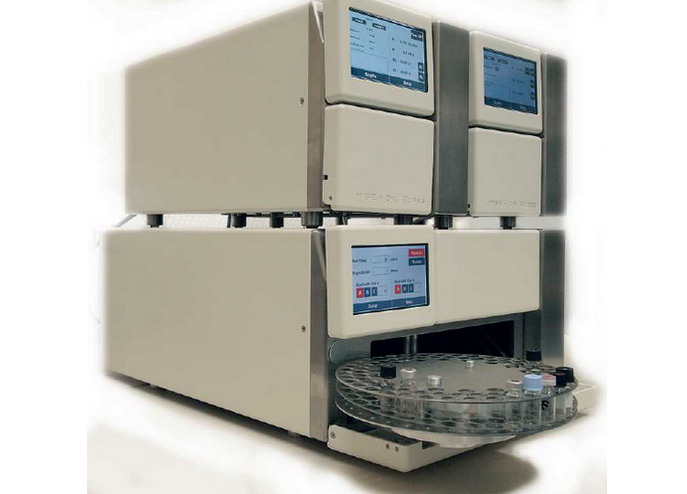
Brookhaven WGE SEC 3010 - system - has been installed in the
"Petru Poni" Institute.
| 
|
This instrument is a high-tech multidetection size exclusion chromatograph designed for high precision molecular weights measurements including absolute values. With this system one can determine Mark-Houwink coefficients for a sample with a single injection, or perform branching calculations without assumptions.
Features:
-
Injection volume: 5- 500 ml
-
Max no. of columns: 6 (300 x 8) + Pre
-
Pump head: Titanium (for any kind of solvents)
-
Columns: 2 sets (polar solvents and water)
-
Detection: RI, Visco, MALS (7 different angles), UV
-
Typical flow rate: 0.3 – 1.2 ml/min
-
Temperature range: ambient – 80 o C
-
Flow accuracy: > 0.04 %
-
Mw range: 500 – 10 M g/mol
Training
Starting from January 22nd, 2013, a specialized working training session was delivered in "Petru Poni" Institute of Macromolecular Chemistry by Klaus Bures, Mike Missbach, Laborchemie GmbH, Vienna, Austria. The principal activities were concerned with: System installation, Components. Software. Demonstration on ICMPP samples. With this occasion the working team from ICMPP learned the new analysis procedure imposed by the particular configuration of the multidetection system.
On May 5th, a second training session has been performed on the field by specialists in hardware and method. Representatives of the producer Klaus Bures, Mike Missbach, Laborchemie GmbH, Vienna, Austria as well as a highly expertise trainer, dr. Carlo Dessy (Brookhaven, USA), worked together with the ICMPP team on: System installation, Standard Calibration, Universal Calibration, Analysis procedure, Parsec software - main modules and data recording, Parsec software - main screen and data interpretation, tests on standards and practice on ICMPP samples.
Additional course/practice sessions have been performed by specialized researchers from the institute on 17.12.2012 - Polymer molecular weight, polymer solutions (dr. Maria Bercea and dr. Simona Morariu) and on 27.06.2013 - Molecular weight measuring methods (dr. Maria Bercea and dr, Simona Morariu). These activities gathered larger number of participants (around 25) from both ICMPP and collaborative research entities.
|
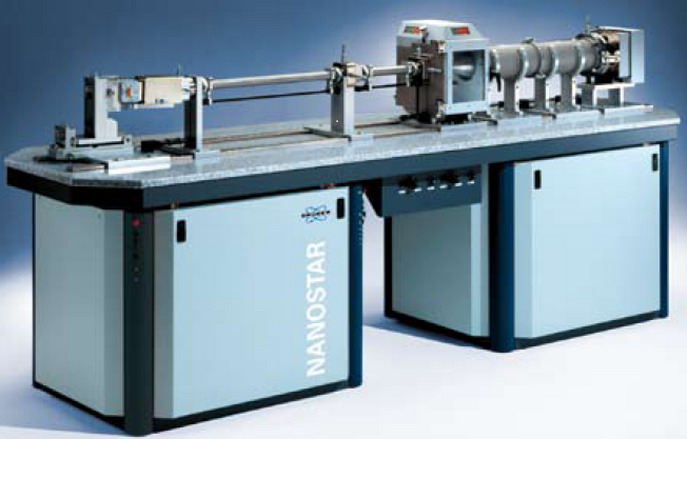
Bruker-Nanostar U - the most advanced instrument for small angle X-ray scattering analysis, has
been installed in the “Petru Poni” Institute of Macromolecular Chemistry.
| 
|
The NANOSTAR U with its incomparable modularity is an ideal solution for analyzing molecular structures ranging from 1 nm to 125 nm and nanostructured surfaces. The 3-pinhole collimation system provides a precisely parallel X-ray beam with high intensity and virtually no background so that fast measuring times and extremely high resolution can be achieved. Consequently, very weakly scattering samples can be analyzed as well as very large structures. The modular design permits setting the detector-to-sample distance from 11.5 mm up to 1070 mm. Hence, the entire range from SAXS to WAXS can be covered.
The NANOSTAR U was installed in a complete configuration which allows SAXS/WAXS/GISAXS analysis in a wide range of temperatures. This complex instrument is your “telescope” to the nano-universe.
Training
On November 19th, 2012, "Petru Poni" Institute of Macromolecular Chemistry organized a training- course focused on the small angle X-ray scattering analysis. The course was sustained by Dr. Livia Chitu from Bruker GmBH. A number of about 30 persons from "Petru Poni" Institute, "A. I. Cuza" University, "Gh. Asachi" Technical University and The University of Agricultural Sciences and Veterinary Medicine Iasi participated to the training seminars and performed practice sessions (groups of 10) on the BRUKER-NANOSTAR U.
Specialized training sessions have been performed in order to establish specific procedures required during maintenance and utilization of the equipment. The first one was on 30.10.2012 and was lead by dr. eng. Peter Seebacher, University Vienna, Austria, with the purpose to learn the module-components functionality, alignment, software, emergency shut-down. Also, analysis through SAXS was demonstrated using samples from ICMPP.
Another training session was done under supervision of dr. Kurt Erlacher, Institute of Materials, Leuben, Austria, starting from 15.04.2013. Activities concerning advanced analysis with NanostarU: GISAXS, SAXS-temperature, SAXS data interpretation, aligning optics, control and adjustment by software (SAXS, GADS), were done on samples from ICMPP.
Beside these specialized training sessions additional course/practice activities have been developed by taking advantage of the partnership with Graz University from Austria, which is one of the leading center in SAXS analysis techniques. Therefore, within 4-8.02.2013, dr. Heike Ehmann, University of GRAZ, Austria delivered a lecture on: SAXS analysis of solids and solutions. Practical examples. Form factor against structure factor, Porod and Guiner curves. Practice on Nanostar U. Analysis of dispersions. The novelty of the technique attracted a large number of participants.
Following, a second visit of dr. Trainer: Heike Ehmann, University of GRAZ, Austria was done during Autumn 2013 with the purpose to consolidate knowledge through practice on the equipment and to start a scientific collaboration on materials characterization by SAXS.
SAXS practice by knowledge exchange continued in GRAZ where dr. Maria Ignat (hired with STREAM funding support) studied SAXS methods with dr. Manfred Kriechbaum followed by visit and working at Trieste - Elletra synchrotron facility.
|
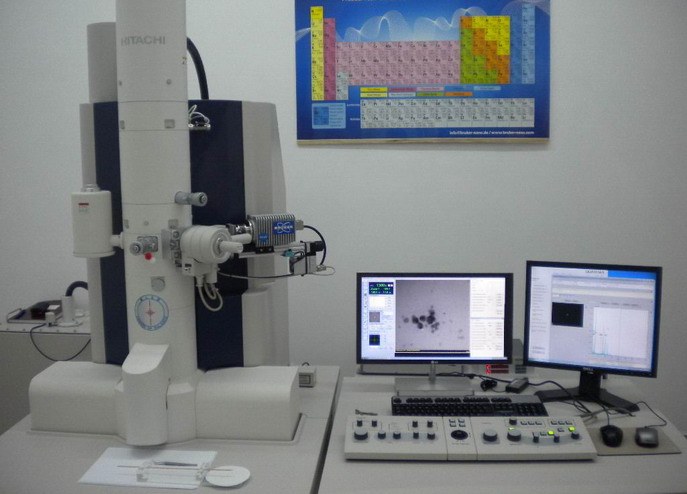
Hitachi High-Tech HT7700 - a New Class of Transmission Electron Microscope Is Installed Now in
Petru Poni Institute of Macromolecular Chemistry, Iasi, Romania
| 
|
HT7700, a new type of transmission electron microscope, is now installed and working in the “Petru Poni” laboratory. The HT7700 was designed with groundbreaking features, chief among these are a superior level of operability and an extensive range of useful digital imaging functions. These features ensure usability across the broadest possible range of applications fields, from the main application area of soft carbon based materials to nanotechnology and biomedical. Furthermore, the decision to integrate a high resolution digital camera and microscope operation has made the system control simplified through the use of one monitor screen possible, which allows for sample observation even under ordinary room lighting.
The HT7700 was installed in a configuration which is unique in Europe: the microscope works in TEM, STEM (bright and dark fields), CRYO TEM and TEM-TOMOGRAPHY modes. This complex instrument allows a deep study of a large variety of materials impossible until now with the conventional TEMs.
Training
On 29 – 31 october 2012, “Petru Poni” Institute of Macromolecular Chemistry organized a training- course focused on the electronic microscopy. The course was sustained by Professor Victor Ciupina from Faculty of Physics, Chemistry, Electronics and Petroleum Technology, Ovidius University Constanta. A number of 43 persons from “Petru Poni” Institute, “A. I. Cuza” University, “Gh. Asachi” Technical University and The University of Agricultural Sciences and Veterinary Medicine Iaşi participated to the training seminars and performed practice sessions (groups of 10) on the HT7700. The training was supported by STREAM project.
An important number of specialized training sessions have been performed even starting from the acquisition of the instrument. The objective of these activities was to teach researchers from ICMPP on exploitation at maximal capacity of the instrument performances and avoid risks of malfunction due to superficial understanding of the operational modules.
These session were performed under supervision of : dr. Martin Lyon, Hitachi High Technologies ( 28.11.2011- 02.12.2011); dr. Joachim Baum, Hitachi High Technologies (28.11.2011- 02.12.2011); dr. Ahner Torsten, Bruker Nano GmbH (28.11.2011- 02.12.2011); eng. Ionut Ailincai, NITECH company, Romania (28.11.2011- 02.12.2011); eng. Codrin Mardare, NITECH company, Romania (28.11.2011- 02.12.2011) Demonstration on tomography and cryo-TEM techniques; Mike Capers, Hitachi High Technologies (23.04.2012- 27.04.2012); Martin Heid, Hitachi High Technologies (12.06.2013- 14.06.2013).
During these activities the team from ICMPP learned in detail about: Coordination/identification/samples selections for TEM analysis; Demonstration on TEM-HC/HR. Emergency shut down; Preparing TEM analysis, TEM analysis techniques; TEM-EDX analysis; Specific recording techniques for TEM analysis; Demonstration on tomography and cryo-TEM techniques; TEM practice on polymer samples from ICMPP (elements of advanced TEM imaging using High contrast/High resolution modules, STEM in high resolution, tomography acquisition of images, etc.); High contrast/High resolution modules, STEM in high resolution, EDX analysis in STEM mode tomography acquisition of images, protective API function, etc)
In addition, dr. Mike Capers, delivered within 25.06.2013- 28.06.2013 a special session dedicated to: TEM practice on polymer samples from ICMPP (elements of advanced TEM imaging using Images reconstruction function, High contrast/High resolution modules, tomography acquisition of images, reconstruction of 3D images, EDX analysis in STEM mode) In this case practice on the instrument was performed with groups up to 5 persons.
|
|